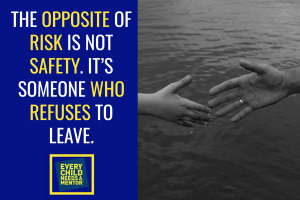
Think of a candle in a completely dark room. It doesn’t need a spotlight or a bonfire to change everything. Just one small, steady flame is enough to chase away the shadows.
For many young people growing up in tough situations—unstable homes, dangerous neighborhoods, or failing schools—that’s what a mentor is. A single, steady flame.
We aren’t talking about superheroes or billionaires. We’re talking about regular people who decide to show up. And that simple act can change a life forever.
Why “At-Risk” Doesn’t Mean “Broken”
Let’s clear something up right away. An “at-risk” youth is not a lost cause. They are not a problem to be solved. They are a teenager or child who:
– Lacks consistent guidance.
– Faces daily pressure from gangs, drugs, or poverty.
– Has been let down by adults before.
They often build high walls to protect themselves. They might act angry, withdrawn, or “too cool to care.” But behind that wall is usually just one quiet question: Does anyone actually see me?
A mentor answers that question without saying a word—just by showing up again and again.
The Real Superpower: Consistency, Not Advice
Here is a secret that most people don’t know: Mentoring isn’t about giving great advice.
It’s not about lecturing a kid to “stay in school” or “say no to drugs.” They’ve heard that speech a hundred times.
Mentoring is about three simpler things:
1. Showing up on a rainy Tuesday. Not just when it’s convenient.
2. Listening more than talking. Letting them vent about a teacher they hate or a friend who betrayed them.
3. Proving them wrong. When a kid expects you to ghost them like everyone else, you call them back. You remember their birthday. You ask about their soccer game.
That reliability rewires their brain. Slowly, they start to believe: Maybe I do matter.
Small Wins That Lead to Big Turns
You don’t need a miracle. You just need small, boring victories.
– Win #1: A mentor takes a kid fishing for three hours. No lecture. The kid finally says, “My dad never did this.” Result: A crack in the wall of loneliness.
– Win #2: A mentor helps a failing student study for one history test. They get a C-. Result: The student realizes, “Oh, I’m not stupid. I just needed help.”
– Win #3: A mentor calmly listens to a teen rage about an unfair teacher. Instead of arguing, the mentor says, “That sounds rough.” Result: The teen learns that adults can be safe.
None of these are Hollywood moments. But these are the moments that stop a kid from dropping out, joining a gang, or giving up.
How You Can Do This (Without a Degree in Therapy)
You don’t need to be a social worker, a cop, or a rich donor. You just need to be you.
Here is a simple checklist to start mentoring an at-risk youth (through a local school, church, or org like Big Brothers Big Sisters or Boys & Girls Club):
– Step 1: Commit to 2-4 hours, twice a month. That’s it. You don’t need to move in with them.
– Step 2: Pick simple activities. Shoot hoops. Bake cookies. Help with a resume. Walk a dog. Do homework side-by-side.
– Step 3: Lower your expectations. They might be rude the first three times. Don’t take it personally.
– Step 4: Brag on them. Find one tiny good thing they did and say it out loud. “Hey, that was really polite to the cashier.”
The Ripple Effect You’ll Never See
Here is the beautiful, frustrating truth: You may never know the full impact you had.
That quiet kid you took for pizza every month? Ten years later, they might graduate college and become a nurse. They won’t call to thank you—because life got busy. But they will mentor someone else. They will remember that someone once believed in them.
That is the ripple. You light one match. They light another match. And suddenly, the whole room is warm.
Final Words: You Are Enough
If you feel a tug on your heart after reading this—a quiet voice saying “I could do that”—please listen to it.
You don’t need to save everyone. Just save one kid from feeling invisible.
Because for an at-risk youth, the most dangerous place to be isn’t a bad neighborhood. It’s being alone with their problems, thinking no one cares.
Be the one who proves that thought wrong.